Inside Norway Cup’s Week-Long Event Economy
Team fees, participant cards and visitor stays create measurable activity around Oslo, Norway, while organizer margin and public return remain only partly visible.

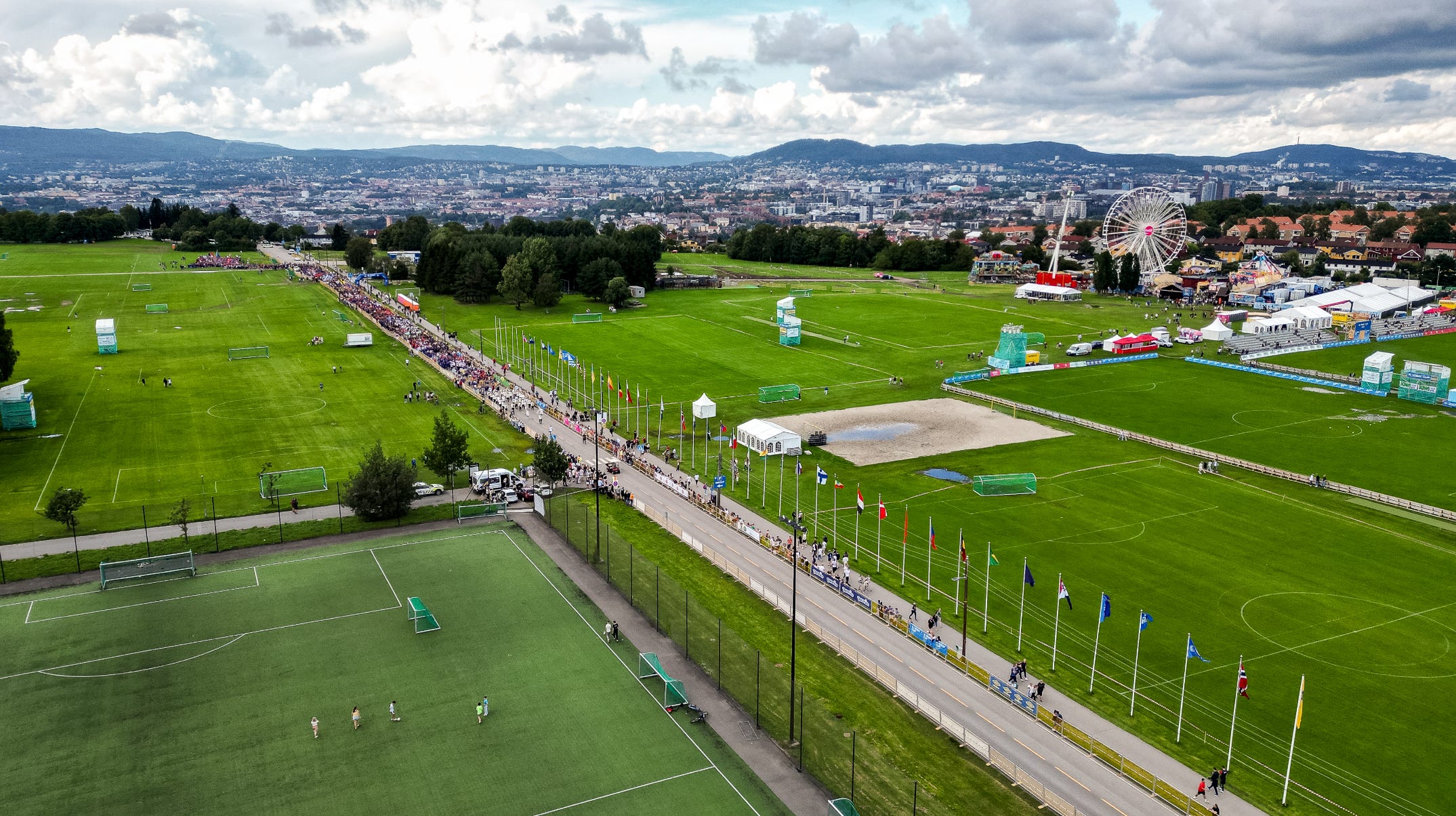
Norway Cup is a week-long youth-football operation in Oslo, Norway, built around team entry, participant cards, accommodation, meals, transport, sponsors and public infrastructure.
The commercial structure is visible. The final return is not.
An Innovation Norway impact calculator estimated NOK 303.9 million in regional value creation from the 2025 tournament. That figure is useful evidence of scale, but it is not Norway Cup revenue, audited visitor spending or Oslo’s net public return.
Participant Cards Create Predictable Volume
Norway Cup’s 2026 team fees range from NOK 845 for 3v3 teams to NOK 6,200 for 9v9 and 11v11 teams. Teams purchasing accommodation cards pay a lower NOK 2,500 team fee.
The larger transaction sits in the cards. School accommodation costs NOK 3,500 per person. Seven-night hotel cards range from NOK 6,950 to NOK 9,500, while other paid products cover meals, transport, airport transfers, mattresses and sleeping bags.
This system gives the organizer advance volume across beds, food and transport. Yet much of the card price may pass through to hotels, schools, caterers, museums and Ruter.
Supplier contracts and unit costs are private, so retained margin per participant cannot be calculated.
The Impact Estimate Needs Qualification
The impact report estimated 52,625 non-local visitors and participants, 368,938 overnight stays and NOK 218.3 million in direct regional demand. Another NOK 85.5 million came from indirect effects, producing the NOK 303.9 million total.
The methodology is more substantial than a publicity claim. It excludes local spending assumed to remain in the region without the event and compares the tournament with a no-event scenario.
Its limitations are material.
The calculator is recommended for smaller or less complex events. Norway Cup supplied the underlying figures, and Innovation Norway states that it cannot guarantee those inputs. The report also warns that regional value creation cannot be compared directly with event costs.
Large Turnover Leaves a Thin Estimated Result
The same report places organizer income at approximately NOK 97 million and expenditure at NOK 94.9 million, leaving an estimated result of NOK 2.2 million.
That is commercially important. A large visitor economy does not necessarily create a large organizer margin.
The figures form part of the impact model rather than a publicly reconciled, audited Norway Cup income statement. Even so, they indicate a high-throughput operation where accommodation, meals, staffing and tournament delivery absorb most income.
The report says any surplus returns to Bækkelagets Sportsklub and the following tournament.
Children Strengthen and Restrict the Sponsor Product
Norway Cup promotes access to roughly 30,000 athletes and 60,000–80,000 daily visitors. Families, coaches and clubs give sponsors a concentrated grassroots-football audience. Those audience figures are organizer claims rather than independently audited reach.
The same audience creates regulatory risk.
Norwegian rules permit sponsorship of nonprofit sport and allow company names, logos and trademarks to remain visible. They restrict product promotion and certain distribution involving specified food and drink categories when marketing is directed towards children.
Norway Cup said the rules could expose approximately NOK 4 million in sponsorship income. The tournament has since extended its Hennig-Olsen relationship through 2028, with activation adapted to the current regulatory framework.
The sponsor proposition therefore depends on useful, compliant activation—not unrestricted product sampling.
Public Infrastructure Carries Part of the Risk
Norway Cup relies on schools, public transport, emergency services and Ekebergsletta. Participant packages include school accommodation and Ruter transport, while the tournament says it serves approximately 120,000 meals during the week.
The impact estimate does not identify Oslo’s complete cost for policing, fire services, school use, waste, transport support, pitch restoration or alternative use of public land.
That exposure became visible before the 2026 tournament, when Norway Cup warned that preceding concert use could affect pitch quality and force matches elsewhere. The organizer described relocation as a significant cost and a reduction in participant experience.
Norway Cup benefits from scale without owning every asset required to deliver it. That lowers capital requirements but reduces control over field condition, public capacity and competing use.
Commercial Verdict
Norway Cup has a measurable business structure. Team fees and participant cards create advance cash flow, full-week accommodation supports predictable procurement and the event generates substantial visitor activity around Oslo.
The evidence does not prove a large organizer margin or a positive net return for the city. The impact model relies on organizer inputs, sponsor economics remain private and public-delivery costs are not reconciled.
Norway Cup should therefore be understood as a high-volume youth-event economy with documented regional activity—not as a NOK 303.9 million business.
Its commercial test is whether a narrow operating surplus, sponsor income and public support can sustain the tournament without pricing out teams or shifting too much delivery risk onto families, volunteers and Oslo.
Norway Cup FAQ
How does Norway Cup make money?
Visible income sources include team fees, participant and accommodation cards, meals, transport products, merchandise and sponsorship. Complete revenue breakdowns and retained margins are not public.
What does a Norway Cup participant card cost?
The 2026 school-accommodation card costs NOK 3,500 per person. Published hotel cards range from NOK 6,950 to NOK 9,500 per person.
Is Norway Cup worth NOK 303.9 million?
No. NOK 303.9 million is an estimated regional value-creation figure. It is not organizer revenue, profit, event valuation or Oslo’s net return.
What was Norway Cup’s estimated operating result?
The Innovation Norway report presents approximately NOK 97 million in income, NOK 94.9 million in expenditure and a NOK 2.2 million result. These figures are part of the impact model rather than a publicly reconciled audited income statement.
Does Oslo profit from Norway Cup?
The tournament is associated with substantial visitor and supplier activity, but Oslo’s net public return cannot be calculated without municipal costs and attributable tax receipts.
Editorial Disclaimer and Evidence Limitations
This is an independent, unpaid analysis based on publicly available Norway Cup pricing, organizer information, sponsorship materials, regulatory guidance, media reporting and the Innovation Norway event-impact report.
The Business Behind Sports was not paid or compensated by Norway Cup, Bækkelagets Sportsklub, Innovation Norway, Oslo Municipality, Ruter, Thon Hotels, Hennig-Olsen or any sponsor, supplier or public agency mentioned.
Public information did not provide a reconciled organizer income statement, participant-card margins, accommodation and supplier contracts, sponsor fees, activation results, volunteer-cost treatment, municipal delivery costs or attributable tax receipts.
The economic-impact study relies on organizer-supplied inputs and standardized assumptions. Its results should not be interpreted as audited organizer revenue, profit, valuation or net public return.
For broader context, read How Sports Events Measure Economic Impact, What Is Sports Sponsorship Activation? and the Norway Sports collection.
For sponsor-package reviews, event business analysis or short sponsor briefs, contact The Business Behind Sports.